Monday, March 28, 2011

Why Startups Need to Blog and What to Talk About

Why Startups Need to Blog.....http://ow.ly/4nZRk
Editor’s Note: This is a guest post by Mark Suster (@msuster), a 2x entrepreneur, now VC at GRP Partners. Read more about Suster at Bothsidesofthetable
Blogs. We all read them to get a sense of what is going on in the world, peeling back layers of the old world in which media was too scripted.
By definition, if you are reading this you read blogs. But should you actually write one if you’re a startup, an industry figure (lawyer, banker) or VC? Absolutely.
This is a post to help you figure out why you should write and what you should talk about.
1. Why
If you care about accessing customers, reaching an audience, communicating your vision, influencing people in your industry, marketing your services or just plain engaging in a dialog with others in your industry a blog is a great way to achieve this.
People often ask me why I started blogging. It really started simply enough. I was meeting regularly with entrepreneurs and offering (for better or for worse) advice on how to run a startup and how to raise venture capital from my experience in doing so at two companies. I was having the same conversations over-and-over again (JFDI, Don’t Roll Out the Red Carpet when Employees are on the Way Out the Door, Don’t Drink Your Own Kool Aid, etc) and I figured I might as well just write them up and make them available for future people who might be interested. I never really expected a big audience or ever thought about it.
I had been reading Brad Feld’s blog & Fred Wilson’s blog for a couple of years and found them very helpful to my thinking so I honestly just thought I was giving back to the community.
The results have been both unexpected and astounding. Within 2 years I was getting 400,000 views / month and had been voted the 2nd most respected VC in the country by an independent survey of entrepreneurs, The Funded and sentiment analysis. I know that I have not yet earned these kudos based on investment returns (although my partners have. GRP Partners last fund is the single best performing VC fund in the US (prequin data) for its vintage year). But it speaks volumes to what people want from our industry:
  • transparency
  • accessibility
  • authenticity
  • thought leadership
  • advice
I’ll bet your customers, business partners or suppliers would love similar.
2. What
I often get the question from people, “I’d like to blog, but I don’t really know what to talk about?” Or “I’m a new entrepreneur, why would I offer advice on how to run a startup?”
You wouldn’t. You shouldn’t.
Not only would it be less authentic but if you’re a startup it’s not immediately clear that other startup CEOs are your target market. They’re mine because I’m a VC. I care about having a steady stream of talented startup people who want to raise money thinking that they should talk to me in addition to the top others whom they’re targeting.
Whom do you want to target? Who are your customers, partners or suppliers?

My suggestion is to blog about your industry. Think Mint.com. In their early days they had an enormously effective blog on the topic of personal financial management. They created a reason for their customers to aggregate on their site on a regular basis. They became both a thought leader in the space as well as a beautifully designed product. They created inbound link juice on topics that drove more traffic to their site. Type “personal financial management” into Google.  Mint.com is the second result. Smart.

Think Magento. They are an open-source & SaaS provider of eCommerce solutions. They are the fastest growing player in the world in this space. They achieved all of this before they raised even a penny of venture capital. eCommerce is an enormously competitive search term. Yet type it into Google and the third result (behind the Wikipedia entry and ecommerce.com) is Magento. Magic. They did it by creating a blog, discussion board and hub for eCommerce advice and information.

So you developed a product for the mommy community? Blog on that topic. Do you have an application that helps mobile developers build HTML5 apps? You know your blog topic. Do you have sales productivity software? Obvious. Check out SalesCrunch posts. Blog to your community. Be a thought leader. Don’t blog to your friend (that might be a separate Tumblog or something) but blog to your community.

If you’re going to pump out regular content that is meaningful, you obviously need to blog about a topic in which you’re knowledgeable, thoughtful and passionate. If you’re not all three of these things in your industry then I guess you’ve got a broader problem. Honestly.

So my biggest recommendation of “what” to blog is a series of articles that will be helpful to your community. If you’re a lawyer, blog on a topic that would be helpful to potential customers. Show that you’re a thought leader. Scott Edward Walker does an excellent job at this. It’s the only reason I know who he is. I had seen his blog & his Tweets and then was interested to meet him IRL.
Do a brainstorming session and create a list of 40-50 topics that interest you. Write out the topic and maybe even the blog title. Keep the list electronically. .

Struggling to come up with enough topics? Take one topic and break it up into 10 bite-sized articles. It’s probably better that way anyways. I wanted to write about the top 10 attributes of an entrepreneur. I wrote it all in one sitting and then broke it up into 10 separate posts. It kept me busy for 3 weeks! Each one ended up taking on a life of its own as the comments flowed in for post 1 I had more thoughts to add to post 2 and so on.
3. Where
You need a blog. Duh. If you’re a company and if hanging it off of your company website makes sense for the link traffic – go for it. If you’re head of marketing at a company and keeping a more generalized blog (in addition to your company blog) so that you can influence brands & agencies – it can be separate.
I chose for my blog to be independent of my firm, GRP Partners.  The reason is that I wanted to be free to say what I was thinking independently of my partners. My views don’t always represent theirs and vice-versa even though we’re pretty like-minded (we’ve worked together for 10+ years).  I chose a title that represented a brand that I wanted to emphasize – Both Sides of the Table. I chose it because I thought it would represent who I am – mostly an entrepreneur but somebody with investment chops. I wanted to differentiate.
So. People keep asking me, “why would you write on TechCrunch?” I guess I would have thought it was obvious. Apparently not. People say, “aren’t you driving traffic away from your own blog?”
Facts:
  • I don’t really care about total page views or uniques other than as a measure of whether I’m improving. I don’t sell ads.
  • I DO care about “share of mind,” which means that I want fish in the pond where the people whom I want to speak with hang out. I know a certain number hit my blog. But I’m not so arrogant (or successful) as to think they come all the time. So I take my show on the road. If I can write about a topic for which I’m passionate about and double or triple the number of people who read it – that’s gold dust. That’s why I never stopped anybody from taking my feed and republishing.
  • As it happens, since I began writing at TechCrunch my viewership has continued to go up, not down. I always publish on my own blog the day after it runs on TC. I want the historical post there. A large number of readers on my site get it from Feedburner or newsletter feed.
  • I also get a lot of inbound links from writing here. I try to make any inbound links to my blog authentic to the story. But each story has driven 1,000′s of views.
  • The majority of my traffic still comes from Twitter. TC posts = more Twitter followers = more conversion when I do write on my own blog = more Feedburner / newsletter subs = more traffic. It’s an ecosystem. Simple.
So once you have a blog, a voice and a small following – don’t be shy about writing some guest posts for target blogs. Remember – for you that’s likely not TC – it’s the place your community hangs out.
4. How
Be authentic. Don’t try to sound too smart or too funny.  Just be yourself.  People will see who you are in your words.  If you try to make everything too perfect you’ll never hit publish.  If you try to sound too intelligent you’ll likely be boring as shit.  Most blogs are.  I hate reading blow hards who try to sound like they’re smarter than the rest of us. Be open and transparent.  Get inside your reader’s minds.  Try to think about what they would want to know from you.  In fact, ask them!
Don’t be offensive – it’s never worth it to offend great masses of people.  But that doesn’t mean sitting on the fence.  I have a point of view and I’m sure sometimes it rankles.  But I try to be respectful about it.  Sitting on the fence on all issues is also pretty boring.  And don’t blog drunk.  Or at least don’t hit publish ;-) Mostly, have fun.  If you can’t do that you won’t last very long.
How do I get started? First, you’ll need a platform.  I use WordPress.  Some people swear bySquareSpace. There are the new tools like Tumblr and Posterous.  I’ve played with both and they’re pretty cool. They’re more light weight and easier to use. Importantly, they’re more social. It’s much easier to build an audience in social blogging platforms the way you do in Twitter or Facebook.  T
hen  you need to decide whether to use the “hosted” version or the “installed” version.  At least that’s true in WordPress.  The advantage of the hosted version is that it’s easier to get started.  The disadvantage is that you can’t install a lot of additional tools that use Javascript. I started with the hosted version and then migrated to an installed version so I could use Google Analytics and some other products.
You then need a URL.  It’s true you can be something like msuster.typepad.com but that’s kind of lame so I wouldn’t recommend it.  Just get a real URL.  I think it’s important to think about what image you want to portray when you pick your URL name.  It doesn’t need to be short.  You’re not trying to build a consumer website.  My website is a pretty long URL but people manage to find it.  Much of my traffic is through referring websites and/or social media. Some search. What are YOU trying to convey?  What will be your unique positioning?  Don’t just write a carbon copy of what somebody else is doing.  That’s boring.
So I wrote a post, now what? Don’t blow your load on your first post.  Slice it up enough to do many posts.  I think most blogs are between 600-1000 words / post.  Once you’re written a few posts don’t try to make the flood gates open at once.  Slowly build your audience.  Make it organic.  If you write good content and consistently you’ll build an audience over time.
The number one thing that kills 95% of blogs is that they do 5 or 6 posts in rapid succession and then peter out. It’s lame to go to a blog where this happens. And then 8 months later they do the obligatory post saying, “OK, I’m going to be more committed to blogging now!” and then another 4 months go by. If you’re really not going to write that often at least don’t put dates on your posts.
But if you write good stuff, but in an effort and keep going – it’s a marathon – you will see results over time.
How do I build an audience? If you build it, will they come? No. A blog post is just like a product. First it needs to be good. And then you need to market it. It doesn’t just happen. You should be subtle about how you market it, but market it nonetheless. If you’re too squeamish to ask for help in promoting it or to do so yourself then you’ll never build an audience (you’ll also likely not make it as an entrepreneur. Sorry. But that’s true.)
The obvious starting point is to email a few friends and let them know you have a new blog.  Don’t be overbearing – just an email saying, “wanted to let you know about my new blog.”  I also recommend you put a link to it under your email signature (in a color other than black).  You also should have it be what your Twitter bio links to.
Every time I write a post I send it out on Twitter.  I try to send out the Twitter link when more people are online.  Over time I’ve found out that I get better clicks at 8.30-9.30am Mon-Fri so that’s when I Tweet a lot of my stuff.  I’ll frequently send two Tweets – East Coast & West Coast. If you want to know why I’ve outlined it here.  Not everybody sees the first one.  Social media is ephemeral.
Because I’ve built my Twitter following slowly but steadily and authentically over time I get very high click-through rates (and thus a high Klout score – currently 74). I get about 4% CTR (click-through rate) on every Tweet in the AM) and it’s actually higher because if I assume only 33% of my followers on online the CTR is closer to 12%.  Interestingly if I had sent one Tweet at 5.30am (to get East Coast time) and another at 8.30am I get 4% CTR both times. So it’s hard to argue you shouldn’t Tweet twice if you have a geographically distributed following.
How do I know my stats? I use awe.sm (disclosure, I’m an investor) which is the best tool I know of for tracking: each individual share behavior (it creates unique URLs for each Tweet) plus it also separates out Tweets from Facebook shares, from “Retweets” that come from somebody clicking on my blog, etc. It also tracks who Tweeted the link so you will know who your most influential social followers are.
Make sure your blog has Tweetmeme or similar to make it easier for readers to Retweet.  Also, make sure to sign up with Feedburner.  That way people who want to get your blog by RSS and/or email can do so. Make sure your blog also has a Follow Me on Twitter button so people who find you can easily follow you.
5. When
People often ask how I blog so much and don’t think they can do it themselves. If you write about something for which you’re both knowledgeable and passionate I’ll bet you can pump out more than you think.
I usually blog at 10pm or on airplane flights. I never blog at work. Like you, I don’t have the time. I have board meetings, company pitches, internal partner meetings, etc. Hell, I often can’t even get to email during the day. So it comes out of TV time, which means I’m not missing anything. Occasionally if I really want to blog and I have a date or too much work I just set my alarm for 5.30am. Yup. It’s not that hard if you make a commitment to it.
What would it mean to you and your business if you could: increase your inbound traffic, enhance your company & personal brand, meet new influential people who suddenly know who you are. If you want these things they are available to you for the cost of some time & effort.
If you plan out what you want to write about in advance (create topics then to headings to structure your article. You’ll notice on this one I started with mine … Why, What, Where, How and then I later added When & What Next) then it’s really about writing.  Structure helps enormously.  If you need some help with the creative process read this.
I write for about 45 minutes to an hour in the first pass.  I usually then re-read, edit, spell check and add links.  This usually takes another 20-30 minutes.  I then always add an image.  I think this is a nice touch.  Just staring at text is a bit boring and I find that the image can add humor and/or drive people in.
6. What Next?
Then there’s comments.  You HAVE TO respond to comments.  Do yourself a favor and installDisqus. It makes a huge difference in driving a comment community.  If you want the details on why I covered it here.
First, it’s the most fun part of blogging.  It’s addicting like Twitter.  It’s where you exchange ideas with other people.  It’s where your community gets to know you.  It’s where you build loyalty and relationships.  I have met many people in person who were first commenters on my blog.  I find it frustrating if I leave comments on somebody’s blog and they never respond.  If somebody found your blog and took the time to comment then they’re like a customer who should be cherished. Responses to them are like customer retention. It’s also where you’ll learn. People will tell you when you’re full of shit.
Appendix: Traffic Hacks:
  • Commenting on other blogs – you need to comment on other people’s blogs.  First, it is a place where your comment will often link back to your blog where it can drive traffic.  Occasionally, and not overtly, and only if relevant you can provide a comment with a link back to an article in your blog.  Don’t do this often, don’t be blatant and make sure it’s relevant.
  • Linking to other blogs – For example, many people know that I love VentureHacks because it’s a great resource for entrepreneurs and I think that Babak Nivi is a star.  Notice I’ve linked to his website.  If he tracks his blog (which I’m sure he does) he’ll see this link.  If he has a Google Alert on his name (everyone does) then he’ll also get that.  Don’t be over the top gushing and creepy.  Be subtle.  Don’t overtly tell everyone you link to, “I linked to you, check out my article!”  Assume that over time if you write compelling content they’ll eventually check you out.
  • Covering relevant people in your blog in an authentic way – If your blog covers topics in your industry it’s likely that you’ll be able to write about some people and companies that you want to be aware of your blog.  Don’t Tweet @ them telling them you covered them. Don’t email them saying you covered them. Just talk about their company. If you write good articles over time and do this often enough people will notice.
  • Tweet support - What I did in the early days was to enlist Tweet support.  I would occasionally ask people that I was close with to retweet my posts.  I tried to mix it up in order to not ask the same people often.  I would send out emails with the Tweet text already written so that they just had to cut-and-paste.  As my blog started getting authentic traffic I stopped asking for this help very often.
  • Guest authoring – Once you have a bit of credibility as a writer a great strategy to drive traffic is to write guest posts for relevant bloggers in your sphere of influence.   If you run BakeSpaceand blog about food why not contact some of the local food blogs and see whether you could submit guest articles.  Most people are delighted to have the free content.  In return all you ask for are links back to your blog and to your Twitter account.  Slowly and surely these will add users, of which some will come back on a regular basis.
Kevin Brown - www.kbsinsight.blogspot.com 

Friday, March 18, 2011

What is Angel Investing?

Marketing by Deepak Gupta http://ow.ly/4hDKG
Investors seeking higher returns, often (ex)entrepreneurs who possess special skills or relationships, sometimes look to non-traditional investments such as start-up companies.  We like to call what these highly aspirational individuals do “Angel Investing”.
Wikipedia definition of an “Angel Investor”: An angel investor or angel is an affluent individual who provides capital for a business start-up, usually in exchange forconvertible debt or ownership equity.
How To Invest Like An Angel
Since the dot com era angel investors have organized and become more sophisticated. Many angel investors now belong to investor groups such as New York Angels.  Investors can find out more about their local, or industry specific, angel group through the Angel Capital Association.
Some benefits of belonging to an angel group according to the Angel Capital Association:
  • Dividing the work eases the time and pain of evaluating and monitoring investments
  • Standardized processes & term sheets
  • Better deal flow – quality and quantity
  • Greater potential to diversify your angel portfolio, and reducing risk of investment losses
  • Stay current on new ideas, technology, emerging markets
  • Networking and fun with a peer group of successful entrepreneurs and executives
  • Build your investment skills by learning from other members
Also popular is going to events such as Y Combinator’s Demo Day and Founders Showcase, where a batch of newly created startups presents to investors all at once.
Networking is essential to surviving as an Angel investor. Angel investors tend to syndicate deals so connecting with other angels will help aspiring and existing angel investors increase deal flow and make better decisions.  Personal referral is still the most common route for angel investing.
“Wait!  Do I Qualify As An Angel Investor?”
Only an accredited investor, defined by the Securities Act of 1933 as a person who has net worth that exceeds $1 million or a natural person with income exceeding $200,000 in each of the two most recent years can qualify to make “angel investments”
Facts, Figures and History of Angel Investors
The term “angel” comes from the practice in the early 1900′s of wealthy businessmen investing in Broadway productions.
The Small Business Administration estimates that there are at least 250,000 angels active in the country, funding about 30,000 small companies a year. The total investment from angels has been estimated at anywhere from $20 billion to $50 billion as compared to the $3 to $5 billion per year that the formal venture capital community invests.
The Center for Venture Research at the University of New Hampshire released some of the following facts about who makes angel investments :
  • The “average” private investor is 47 years old with an annual income of $90,000, a net worth of $750,000, is college educated, has been self employed and invests $37,000 per venture.
  • Seven out of 10 investments are made within 50 miles of the investor’s home or office.
  • Investors accept an average of 3 deals for every 10 considered. The most common reasons given for rejecting a deal are insufficient growth potential, overpriced equity, lack of sufficient talent of the management, or lack of information about the entrepreneur or key personnel.
The Top Angel Investors
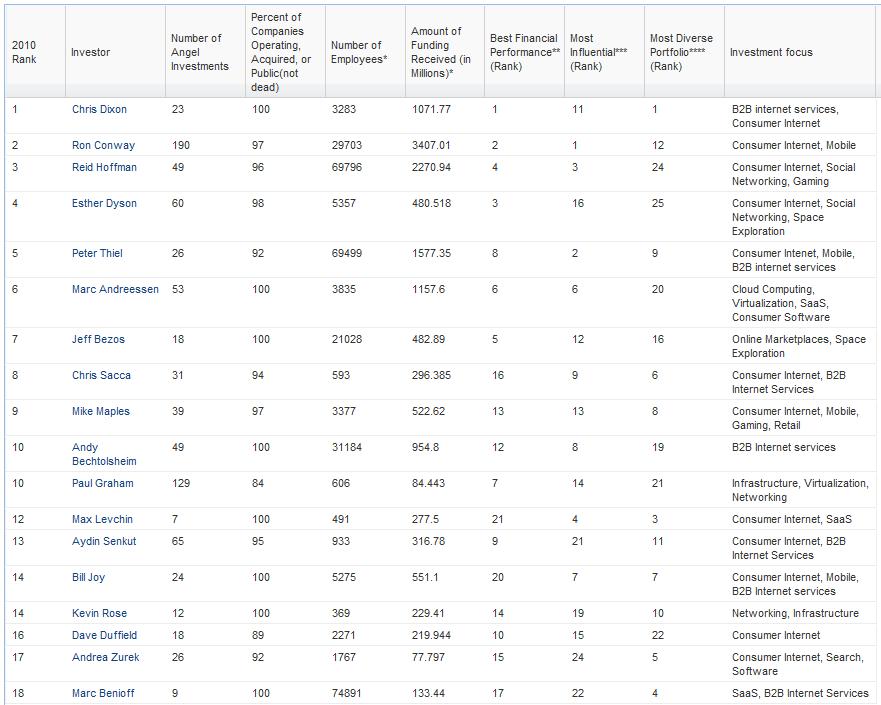
In a fantastic roundup of the top angel investors in the U.S., Business Week asked startup tracker YouNoodle to conduct some research.  It turns out the top 25 angel investors have helped fund 740 new companies, create 328,698 jobs, and raise $15.2 billion.   This is what the list looks like….
top25angelinvestors 300x240 Devon George: What is Angel Investing?
Top 25 Angel Investors

Some additional stories from Business Week about successful angel investors:
Everybody has the potential to be a successful Angel Investor.  I hope you find yourself on that path soon.
Kevin L. Brown www.kbsinsight.blogspot.com 

Lead Generation: The Formula for Success

KBs note- This is a great article from my friend Deepak Gupta @dpak5150 


Lead Generation: The Formula for Success http://ow.ly/4hzSk


To be successful in Lead Generation, a good Marketer has to embrace, align and harmonize all the elements involved. Together, these form the equation:

Lead Generation = (Branding + SEO + Social Media + Traditional Marketing + Customer Svc + PR + Mobile Marketing + Landing Pages)
Let’s examine each element briefly –
Branding: According to Brand Strategist, Richard Harmer, “Brands build loyal customers by consistently meeting their needs . . . it is like a reputation or gives one a certain feel or charisma that is not substitutable.”
SEO: Search Engine Optimization is simply being in the right place and time when your customer is on the prowl for your service or product. And if you are there to help them right when they need it with a strong online presence – they will be more likely to purchase from you.
Social Media: Relationships are everything and the same can be said about developing relationships with consumers. For instance, I believe companies should use Twitter as a customer service channel.
Traditional Marketing: There are consumers who still watch TV on a TV, see billboards on the freeway, receive direct mail and even read paper periodicals. The only drawback to targeting this demographic is traditional advertising can be expensive and requires detailed ROI analysis.
Customer Service: Every time you lose a customer, it costs 5 – 6 times more to acquire a new customer than to retain or up-sell your existing ones. Use sales and marketing to increase your base and customer service to ensure retention.
PR: Networking Guru Hank Blank, says “Last year I sent out four press releases on Business Wire about some of my marketing engagements, speaking events, and thought leadership. Why? Because they help my organic SEO dramatically and provide validation material for pitching new business. And I know the value of being above the crowd.”
Mobile Marketing: Projections suggest that phone- and tablet-based Internet access will continue to increase. Therefore, this is a mandatory channel for the savvy marketer.
Landing Pages: Many times, I have seen an ad, clicked and then was directed to a page that has nothing to do with the product/service I looked for. Mary O’Brien admonishes marketers not to build a “bridge to nowhere.”
Lead Generation: These elements need to constantly feed each other as one integrated strategy – an IMC (Integrated Marketing Communications) plan – to be effective. Consumers should be able to feel the harmony and consistency in their interaction with your company.
Completing the Sales Cycle by Nurturing your Leads
It takes times for an egg to fully develop and hatch. Think of your lead generation as an incubator. You need to nurture and make them feel comfortable about you!
In our current economic climate, companies need to innovate and not hesitate to use highly targeted marking techniques to invigorate your life’s blood: consumer relationships. Using the “spray and pray” approach and expecting sales to be pulled out of a hat is unsustainable.
Terms like “SEO” and “social media” are being abused by charlatans. For instance, garnering a large presence online is a great way to establish credibility; however, you need a long-term monetization plan.
Being involved in marketing means nothing unless you are paying attention to attracting self-qualified leads to justify your marketing investment. Consumers are more savvy and selective than anytime in history.
Directing visitors to interactive landing pages and offering free whitepapers, e-books or special offers for commodities is the smart way to work in a lengthy sales cycle and consumer driven market and address the consumer’s question “What’s in it for me?”
Why the Quick Fix won’t work
Many companies still want the quick fix. Using dating as a metaphor, they liken being online for a short time to going to the singles bar. Business isn’t built from one night encounters but by fostering relationships. Provide people with added value; closing the sale will follow.
For instance, some companies will try AdWords for a week, not get immediate gratification and move on. Like a one night stand, lead generation doesn’t work like that and requires nurturing. You have to be seen repeatedly, but with an appropriate frequency.
That is how your awareness spreads and your reputation grows. When humans get to know you, you earn their trust and they become more engaged. You earn respect through demonstrating thought leadership.
**************************************
Deepak GuptaDeepak Gupta is serving as the VP of Marketing for Help My Resume, a Florida-based non-profit and is the Founder of California-based Marketing By Deepak Consulting Group. Marketing By Deepak Consulting Group partners with clients and successfully converts their marketing efforts into qualified leads.
Kevin L. Brown www.kbsinsight.blogspot.com 

Wednesday, March 16, 2011

Top 9 Smartphone Etiquette Blunders


Mar 14, 2011 -
OPEN Forum http://ow.ly/4fNII 

Katie Morell


We’ve all been in a meeting where the person across the room is busy Tweeting or Facebooking under the table. Or out to lunch with the person who so tethered to their smartphone that they place it on the table, right next to their fork, for the entirety of the meal. Meanwhile, you are getting antsy, wondering when your conversation will be trumped by the latest Rihanna ring tone.

Almost everyone has a smartphone these days. I was one of the holdouts until about two weeks ago, when I broke down and got the Verizon iPhone 4. I love it. But as a PDA late bloomer, I’ve spent the last two years becoming keenly aware of the loss of social etiquette when it comes to these devices. They don’t call them Crackberries for nothing.

So what are the 10 biggest smartphone etiquette blunders?

1. Multi-tasking
“Don’t multi-task and send text messages or read e-mails while you are in conversation with someone,” suggests Shelley Davis Mielock, chief image expert at Mieshel Image Consulting in Lansing, Michigan. “If you are sitting at a table with someone and you are sending a text message at the same time, it shows the person in front of you that they are not important to you. It also makes them feel rushed.”


2. Typing quickly

“Make sure to always use spell check,” advises Davis Mielock. “Every message you send is an extension of your personal and professional image. I know people type in ‘please excuse misspellings,’ but you should really be checking each and every time. Take that extra second and treat each correspondence as if you were sending a letter from your office.”


3. Turning on vibrate

 “The vibration is a distraction—everyone can hear that,” says Rachel Wagner, a certified corporate etiquette consultant, trainer, and speaker in Tulsa, Oklahoma. “Keep your device on silent and put it in your pocket while you are in a meeting. If you are expecting an urgent call, excuse yourself and take the call in a private place.”

4. Participating in ‘lap reading’
 “Everyone can see when you head is lowered and you are focusing on your smartphone,” Wagner says. “This causes you to look disengaged and prevents you from having eye contact. It is also really rude and gives a terrible impression.”

5. Leaving long-winded messages
 This one goes for all phone users. “Don’t leave long, complicated voice messages where you speak so fast that it sends the other person scrambling for a pen to write it all down,” says Alison Blackman Dunham, co-founder of Advicesisters.net, a life and advice site. “The best thing to do is to just say, “Hi, I need to talk to you about so-and-so. Please call me back.’ Then leave your number and hang up…simple as that.”

6. Putting someone on an extended hold
 “When you say you are putting someone on hold for just a moment, it should be for just a moment,” says Blackman Dunham. “Business people are busy. If you can’t talk to someone, tell them you will call them back and give them an exact time; it is the courteous thing to do.”

7. Having a ringback tone
 “Ringback tones are not for professionals…unless you are a pop star,” says Davis Mielock. “If I am calling a banker to inquire about a mortgage loan and he has a rapper ringback tone, I will call his credibility into question.”

8. Talking in front of others
 “Excuse yourself,” Davis Mielock suggests. “Don’t have conversations in front of other people at all, especially professional conversations. It is incredibly inconsiderate to the people around you.”

9. Interrupting face-to-face conversation
 “I’ve known people to be in the middle of an in-person conversation and just start typing away on their smartphone,” says Wagner. “They don’t realize how that comes across. That behavior sends the message that the text is more important than the person standing in front of them and causes feelings of disengagement from your conversation partner.”

Kevin L. Brown www.kbsinsight.blogspot.com

Demonstrating Leadership when Handling a Disgruntled Employee

by Dr. Rick Johnson - http://ow.ly/4fNbt
March 10, 2011
     “Are you kidding me?” ---- “I can’t believe you are doing this to me!” -----“This just isn’t fair”
Have you ever heard those words or similar words from an employee?  Have you ever had to handle a situation where an employee is so upset they become very emotional? If you haven’t and you are in management, you will. It’s just a matter of time.

Avoid Confrontation
Anytime you're dealing with an employee who's disappointed, avoid getting emotional or confrontational, regardless of the employee’s attitude.  Disarm the confrontation and diffuse the emotion simply by using words and phrases indicating you care about the employee and understand his or her concern.  The most powerful words you can use are, “I understand, and we're sorry this happened.”  You can apologize for something that has occurred even if it’s the employee’s fault.  For sure, you're sorry that the employee really messed things up, and it's okay to express disappointment as long as you do it without criticism. Knowing someone is disappointed in you or knowing you failed to meet someone’s expectations often reaches deeper inside than any kind of reprimand or “constructive criticism."
Other phrases you can use include:
  • I’ll take care of this.
  • I understand why you're upset.
  • I’d feel the same way.
  • I’ll check into this situation right now.
  • We had a misunderstanding.  Please, let’s take this opportunity to fix it.
  • How can we work on this together?
Complaining is a Message
A complaining employee is sending you a message, and you must determine exactly what that message is. Does it have merit? Is the employee just whining? Is the employee utilizing complaints to cover his or her own short comings? How serious is the issue? Some employees who feel you have not met their expectations don’t say anything, they just shut down. They do only what they have to do.  In other words, they never release the discretionary energy, which enables them to strive to exceed expectations.  If an employee is unhappy in his or her job and doesn’t say anything to you at all, chances are you have not earned his or her respect as a manager. So, view a complaining employee as an opportunity to build relationship equity, an opportunity to earn his or her trust and respect. That doesn’t mean you have to "kiss up" and do anything the employee wants.  But it does mean you should listen to every complaint. If it’s just whining, don’t be afraid to tell the employee he or she is whining.  And if that’s the case, make sure you know the facts and you're on solid ground.  After all, the employee will also make a judgment as to how well you handle his or her complaint¾how you handle the situation.  If you handle it right, you may gain even more loyalty.

Show Compassion
Showing compassion for the employee’s situation and empathizing with his or her feelings is a powerful substitute for becoming defensive and argumentative.  A solution cannot be reached until your employee feels your concern through your attitude, your tone and other communication signals.  Compassion and empathy demonstrate a concern and respect for the employee even if you have to enforce policy and tell the employee he or she is wrong.
No matter what the situation, don't lose control, and don’t be argumentative.  Focus on solving the problem and showing the employee you’re concerned about his or her feelings.  Stick to the facts, and then determine what the problem is.  Determine what it's going to take to correct the problem. Figure out what it will take to retain the employee relationship.  Sometimes just solving the problem isn’t enough.  It’s how you solve the problem and how you make the employee feel about the interaction to reach the solution.

What if the Situation Warrants a Reprimand
It's probably a rare circumstance where an employee will come to you with a self-incriminating complaint. However, a complaint by an employee could cause you to investigate a situation and determine the complaining employee was so out of line or violated policy in such a manner that some form of reprimand is necessary. Regardless of the circumstance, its imperative the employee has a complete understanding as to his or her personal responsibility in the situation.Remember:  Coaching and mentoring is key to effective leadership, but it does not mean that you abandon your managerial responsibilities.
The majority of employees are coachable and want to do a good job, exceeding all expectations. But, majority does not mean 100%. You have to know when to change from "coach" to "manager." It's not an impossibility that you may have hired the wrong person; we all make mistakes. Don’t over-invest in an employee that just isn’t going to be the right fit for the job. A key to making that determination is attitude.  How does the employee respond to your guidance, your help, your suggestions and your questions?
An effective leader will use the "servant supportive" leadership style more than 95 percent of the time. The key to a leader's effectiveness is knowing when to use the "autocratic dictatorial" style.

Monday, March 14, 2011

Five Simple Ways to Keep Your Twitter Followers Happy

 Twitter blog and news http://ow.ly/4ezTV
Twitter can be a volatile place. Most of the time your followers don’t give you an explanation for why the followed you in the first place, and the same holds true for when they stop following you. That can make it hard to know if you’re “doing it right.”
There are, however, a few simple factors which hold true across the majority of Twitter users; figure out how to balance them properly and you’re practically guaranteed to keep the majority of your Twitter followers coming back for more. Knock them out of whack, though, and you could see that follower list of yours start to dwindle quicker than you might expect.

Five Simple Ways to Keep Your Twitter Followers Happy

  1. Find Your Frequency.
  2. People get their Twitter updates in lots of different ways; on their PC’s, on their smartphones…even by SMS in a lot of cases. With that in mind, you need to understand that your followers aren’t just following you – they might be following hundreds, even thousands of other people. Nobody likes seeing their Inbox full of emails from the same person – and the same thing holds true for their Twitter feed. Find the sweet spot between tweeting too much and tweeting too little. Updating your Twitter once or twice a month? Don’t expect too many people to remember who you are, and don’t expect to garner too many new followers. Tweeting 30+ times per hour? Expect that a significant number of your followers are going to get sick of you and unfollow. Strike a balance and maintain it.
  3. Keep That Rage in Check
  4. Nobody likes a whiner – and on Twitter, it’s easier than anywhere else to turn your back on one. Take a hard, long look at yourself when you’re in a bad mood and ask yourself whether everyone on your follower list really needs to experience that firsthand. Nobody will fault you for occasionally griping about something, and as long as you can keep it entertaining, you can get away with quite a bit, but at some point everyone has a line, and you should make sure you don’t cross it. If you’re too angry to control yourself, log off of Twitter. If you’re able to control it, and even better, if you’re able to make jokes about it and stay on top of the situation, then do so, but move on to other topics before people can start to accuse you of being a moaner.
  5. Everyone Loves to Laugh
  6. Without a doubt, some of the most successful people on Twitter are also some of the funniest. There’s something about the 140-character format of Twitter that elevates certain people’s humor to nearly side-splitting levels, and those are the people who find the most success on Twitter. If you can keep your followers laughing, they’ll never turn their backs on you. Making jokes about realtime news, for example, is a good way to get yourself retweeted, which is a good way to reach followers that you normally wouldn’t have access to. Just make sure that your humor doesn’t cross the lines of acceptable behavior – even in this day and age, there is such a thing as taking a joke too far.
  7. Tell Us About Yourself
  8. Some people can pull off mysterious Twitter stranger, but let’s be frank: most of us just don’t have a strong enough Twitter personality to do it. If you really want your followers to get endeared to you, tell them things about yourself! As a baseline, Twitter people will usually follow you longer if they know your gender, nationality, rough age, and most particularly, your interests. Don’t be shy! Social networking represents the largest shift toward ego-centrism that the world has ever seen, and Twitter is no exception. Choose one day a week to share facts about yourself with your Twitter followers. If you really want to make it fun, turn it into a game – tell them four true things about yourself, and one lie, and ask your followers to guess which is which.
  9. Engage, Engage, Engage
  10. Unless you’ve got so many followers that you’re getting thousands of Direct Messages and @Replies every day, it’s expected that you’ll reply when people message you directly on Twitter. If you don’t, they’ll quickly get the impression that you don’t care about them or don’t think you’re interesting and they’ll move on to someone who does reply. For truly engaged Twitter followers, take it one step farther – don’t just reply when they contact you. Instead, be pro-active and make occasional first contact yourself! That will really let them know that you value them as followers and value the conversations that you have together. Even better, retweet them sometimes to show that you think their tweets are worth sharing.
There you have it, Tweeple! Five simple, straightforward ways you can increase your follower retention. Put that together with some of our tips for gaining more followers and you’re bound to see your count go up in the coming days and weeks.
Kevin L. Brown www.kbsinsight.blogspot.com